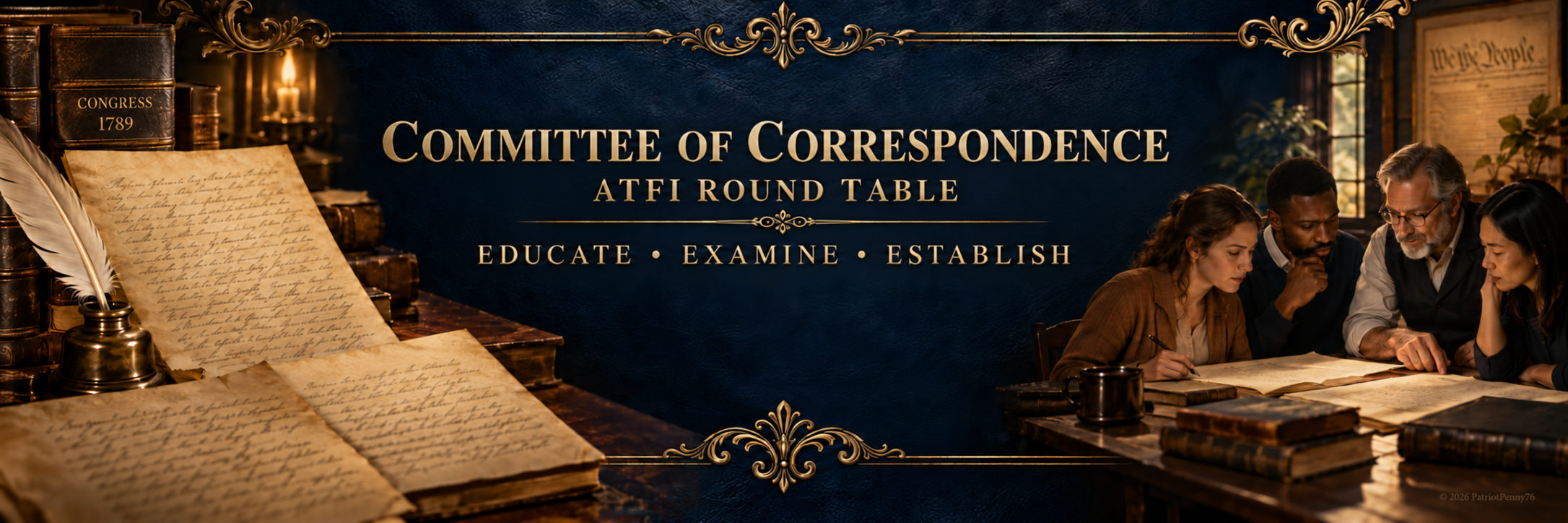
Article the First Initiative ™ Roundtable
Educate • Examine • Establish
The Article the First Initiative ™ Committee of Correspondence brings forensic researchers together—from kitchen tables to individuals’ own oval offices—to examine historical records, exchange documented information, and collaborate in recovering the story of Article the First and constitutional representation.
You do not need an academic title or professional research office to participate. You need curiosity, integrity, patience, and a willingness to follow the evidence wherever it leads.
Every carefully documented contribution can add another piece to the historical record.
The Historical Committees of Correspondence
Before the American Revolution, citizens and colonial leaders needed a dependable way to exchange information. News traveled slowly, and communities were often separated from one another. Letters, pamphlets, and trusted messengers became essential tools for reporting government actions, sharing evidence, and comparing what was happening in different places.
In November 1772, Samuel Adams proposed that the Boston town meeting establish a standing Committee of Correspondence. Its work was to state the rights of the colonists, document violations of those rights, and communicate that information to other towns throughout Massachusetts.
Those towns began forming committees of their own. In 1773, Virginia established a committee to correspond with the other colonies, and similar committees soon developed elsewhere.
These committees helped separate communities recognize that their concerns were connected. Citizens gathered in their local commons, examined what government was doing, recorded their conclusions, and carried that information outward through correspondence.
They did more than exchange letters. They created an informed network of citizens capable of comparing evidence, correcting misinformation, and cooperating for the common good.
That history reflects what we are establishing through the Article the First Initiative Roundtable.
What We Do at the Roundtable
The research itself generally takes place outside the Roundtable. The Roundtable is where we come together to coordinate and share that work.
At the Roundtable, we:
- Receive completed research and supporting documentation.
- Introduce research that has been submitted and reviewed.
- Briefly identify work currently underway.
- Coordinate research needs and assignments.
- Share verified research being prepared for the ATFI website, educational materials, or future presentations.
- Bring ATFI-related information to the table through three-minute forensic briefings.
This structure gives participants a voice while also allowing evidence to be examined carefully before ATFI reaches or publishes conclusions.
Three-Minute Forensic Briefings
The three-minute forensic briefing gives participants an opportunity to bring ATFI-related information to the table.
A briefing may concern:
- A historical person, such as James Otis.
- A court case, such as Marbury v. Madison.
- An original congressional or state document.
- An historical event connected to representation.
- A new research discovery.
- Activity taking place within a state.
- A question or claim needing further investigation.
- Another subject connected to Article the First or constitutional representation.
The three-minute format allows the Committee to receive the information and recognize its possible value without turning every briefing into a lengthy discussion.
When information calls for deeper examination, its supporting documentation may be submitted for review. A fuller discussion can then be scheduled for a future Roundtable.
Research Review and Submission
Our purpose is not to prove one person’s position. We examine the record honestly, welcome questions and corrections, and follow where the evidence leads.
When research or educational material is submitted, ATFI will:
- Identify what has been received.
- Determine where it fits within ATFI’s research or educational work.
- Review the supporting sources and documentation.
- Discuss or publish material that has completed review.
- Set aside anything needing correction, verification, or further examination.
Submission does not automatically mean that ATFI endorses the material or its conclusions. Review helps protect the integrity of the historical record and the educational work built upon it.
Research Needs and Assignments
The ATFI Education Action Guide provides an overview of our current research areas and the different ways people can assist.
Research needs may include:
- Locating original congressional or state records.
- Verifying citations and source links.
- Transcribing historical documents.
- Comparing different versions of a record.
- Building chronological timelines.
- Examining historical or legal claims.
- Researching anticipated pushback.
- Helping present verified findings in language the public can understand.
Participants may select an available assignment or submit something independently discovered that may be valuable to ATFI.
New participants do not need to begin with a large project. You may start with one document, one citation, one comparison, or one question.
The Action Guide is not a finished plan set in stone. It is a working trail guide that will continue to develop as new evidence is submitted and our understanding grows.
[Contact us for the latest edition of our ATFI Education Action Guide]
Collaboration in Practice
The Committee of Correspondence welcomes different forms of contribution and collaboration.
Karen U. submitted educational posters for review and public use. After review for historical accuracy, the posters were added to the Posters section of the ATFI website for others to download and share.
Karen also submitted a research report concerning Coleman v. Miller. Because that report called for further examination and correction, it was held for continued review before any decision concerning discussion or publication.
Philip W. submitted a script for review. Several participants later met with Philip on Zoom to discuss his project, ask questions, exchange ideas, and help the work develop.
These examples demonstrate how collaboration can take place: a participant identifies something that may benefit the initiative, prepares it, submits it for review, and works with others to develop accurate educational material.
Who May Participate?
Participation is open to:
- Current ATFI researchers.
- People interested in taking a research assignment.
- Book-study participants.
- Educators and collaborators.
- People who have located a potentially valuable record or source.
- Anyone seeking a better understanding of Article the First and constitutional representation.
The Roundtable is centered on ATFI research and education. It is not a general current-events meeting or a place for unrelated organizational business.
Join the Committee of Correspondence
The Article the First Initiative Roundtable meets online every Tuesday Evening.
Doors Open: 7:55 PM ET
Roundtable Begins: 8:00 PM ET
Online: www.EducateGrowGlorify.com
Zoom Meeting ID: 741 776 2024
Call In: 669-444-9171
Submit Research or Ask a Question
If you have located a document, citation, historical claim, court case, state record, or other information that may benefit ATFI, please contact one of our team members.
Include the original source or the strongest available documentation whenever possible. If you are uncertain where your discovery fits, submit the question with the material so it can be considered during review.
or submit materials below
A Living Process
The Article the First Initiative is a living educational process. Our understanding will continue to develop as original records are located, evidence is compared, questions are answered, and corrections are made.
Through this modern Committee of Correspondence, citizens separated by many miles can bring their discoveries together, examine them carefully, and help educate the American people about Article the First and constitutional representation.
Education is where restoration begins.